
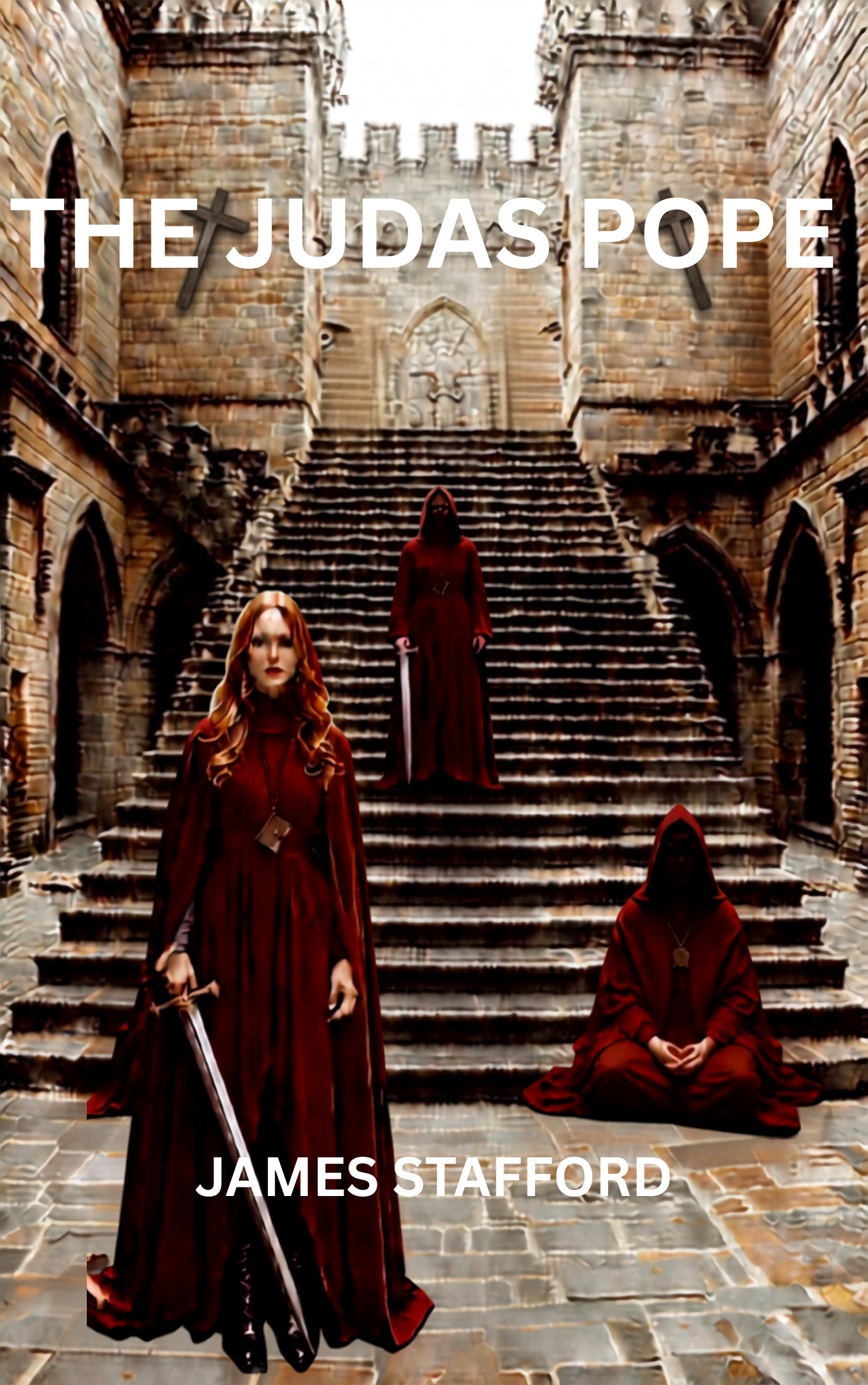
As a predominate part of its background and subtext, the novel “The Judas Pope” explores the past and fanciful future conflict of traditional Western Christianity, with its belief of some form of immortality in Heaven or Hell following final judgement with the ancient Christian Gnostic “heresy” as exemplified by the Cathar (sometimes referred to as Albigensian) creed which (likely) included a belief in reincarnation as a central core of its theology.
The theory of life after death in all of its permutations is a tantalizingly attractive concept. The certainty of death gives us all reason to pause and to tremble. Especially in Western cultures many attempt to avoid even considering or speaking of it in concrete terms, at least as it applies to us or our loved ones, ignoring or making light of its terrible inevitability until circumstances force us to face its inescapable and brutal reality.
There are disparate ways of considering and dealing with the approach of the “Grim Reaper,” a Western personification of death that says much about our attitudes. Death may be seen as a fearful enemy for those who contemplate the permanent termination of their own consciousness or the passing of loved ones whose presence and company can never be replaced. We have a terror of death only partially mitigated by the knowledge that it is a fate universally shared. This dread of death seems to be widespread although not universal since for some it ultimately may be viewed as a welcome release from unbearable suffering. Indeed, both secular and religious philosophers have speculated that illness, pain, and the infirmity of old age are nature’s (or God’s) way of making the awareness of impending death tolerable.
Many emphasize their faith as a way to mitigate the terror of death, a welcomed refuge from its terrible wrath, accepting what skeptical outsiders may deem as fantastical promises of eternity, heaven, or paradise in return for total submission to one of countless theologies, each convinced that their faith alone reflects the truth. The less religiously inclined may rage against the injustice of death, angry that the world will go on with scarcely a hiccup to delineate their passing. Others assert, with questionable credibility, that they simply accept death as a part of life, not something to be feared but calmly accepted, a component of the eternal cycle.
The conflicting concepts that some form of personal immortality is possible or universal forms the basis of seemingly irreconcilable theologies not only between the major worldwide religions of today but, for the last twelve hundred years or more of the modern era, within various competing branches or sects that called themselves Christian. Death and the promise of life after death in some form preoccupies most religions, with the possible exception of Judaism which seems to deemphasize the entire issue without necessarily rejecting it outright, favoring emphasis on conduct and worship in this life.
Some secular scholars argue that without death there would be no religion and no purpose for it. Religions are too numerous and diverse to easily accept that interesting proposition but certainly it is difficult to conceive of any recognizable form of Christianity without death.
Reincarnation (or rebirth or the transmutation of the soul) is considered by highbrow cynics to be only an absurd fantasy, superstitious nonsense, a delusion caused in part by terror induced by the prospect of inevitable death. It also is the realm of countless charlatans more than willing to suggest personal immortality to the gullible or desperate in exchange for the transfer of wealth, offering a more tangible alternative to more esoteric concepts of life after death. In traditional Western religion, with its seemingly opposing notion of immortality, reincarnation often is seen in even more ignoble terms: at best as foolishness, at worst as a grotesque and dangerous heresy which not only must be rejected but ridiculed and destroyed lest it contaminate, even damn the credulous faithful. Yet, the belief in reincarnation has persisted in much of the world for thousands of years and today is accepted by hundreds of millions (perhaps billions) of the living as religious dogma and incontrovertible fact.
The role of reincarnation in the musings of ancient philosophers is ubiquitous and has been widely referenced in literature at least from the time of Plato with his conviction of the constant rebirth of the soul. A few examples of ancient and more recent philosophers:
________________________________
“I am confident that there truly is such a thing as living again, that the living spring from the dead, and that the souls of the dead are in existence.”
Socrates
________________________________
“As a casting off worn garments for new ones, so the dweller in the body enters into ones that are new.”
Epictetus
________________________________
“The doctrine of reincarnation is neither absurd nor useless . It is not more surprising to be born twice than once.”
Voltaire
________________________________
“A little while, a moment of rest upon the wind, and another woman shall bear me.”
“The Prophet” Kahlil Gibran
________________________________
Reincarnation also is manifested in a number of Eastern religions, most prominently Hinduism, Buddhism, Sikhism as well as in the gentle faith of Jainism. It is noteworthy that all in some form see reincarnation and life itself as an undesirable burden, a test only to be escaped through enlightenment, much as the philosophy held by the modern Gnostic Cathars depicted in my new novel “The Judas Pope” (but in “The Judas Pope “ this view is rejected by its offshoot, the perplexing Sisterhood, who see reincarnation as a gift of renewal, essential both for individual growth and the future of human civilization while bestowing unexpected knowledge, powers and challenges and fostering the next step in human evolution).
A few examples of reflections of reincarnation in Eastern religions:
________________________________
“The spirit is neither born nor does it die at any time…. The spirit is not destroyed when the body is destroyed, Just as a person puts on new garments after discarding the old ones, similarly the living entity or the individual souls acquires new bodies after casting away the old.”
Bhagavad Gita (Ancient Hindu text)
________________________________
“Long is the cycle of birth and death to the fool who does not know the true path.”
Gautama Buddha
____________________________________
I would be remiss if I failed to mention the Dalai Lama, believed by many of his Buddhist followers to be the 14th reincarnation of the spiritual leader of Tibet and perhaps the 74th in a lineage tracing to the time of Gautama Buddha, the founder of the philosophy (although a Buddhist might demur, explaining the subtle difference between reincarnation of the soul as a Hindu might understand the term and the Buddhist concept of rebirth).
________________________________
From the Sikh religion we have:
“Their coming and goings in reincarnation do not end; through death and birth they are wasting away.”
Sri Guru Granth Sahib Ji page 4
________________________________
Even in the West the concept of reincarnation has a long history. In current times it has been the subject of intense academic study, especially at my alma mater the University of Virginia where the UVA Division of Perceptual Studies (School of Medicine) for over fifty years conducted interesting if non dispositive studies of the evidence supporting this ancient belief that may suggest at a minimum that reincarnation should be further studied and reconsidered in scientific terms.
Reincarnation is frequently referenced both in prose and poetry (and in modern country/western songs such as “El Paso City” written and performed by Marty Robbins; this song is one of my favorites for deeply personal reasons If intrigued, you should first listen to Robbins’ hit “El Paso” since “El Paso City: is a direct reaction to it in modern times).
A few literary examples are referring to reincarnation are indicated below:
________________________________
“I know not how, I know not where
But from my own heart’s mystic lore
I feel that I have breathed the air
And walked this earth before.”
“Reincarnation” John Lawson Stoddard
________________________________
“So through a glass and darkly
The age long strife I see
Where I fought in many guises
Many names…but always me.”
Through a Glass Darkly” General George S. Patton, Jr.
(1922)
________________________________
“The soul comes from without into the human body as into a temporary abode. ..it then passes into other habitations for it is immortal.”
Ralph Waldo Emerson
________________________________
“As we live through thousands of dreams in our present life so is our present life only one of thousands of such lives which we enter from the other more real life and then return after death.”
Leo Tolstoy
________________________________
“I did not begin when I was born nor when I was conceived. .. Oh, the incalculable times again shall I be born.”
Jack London
________________________________
“I am certain that I have been here as I am now a thousand times before and I hope to return a thousand times (more).”
Goethe
________________________________
“I would sing the pre-existence of human souls
And live once o’er again
By recollection and quick memory
All that has passed since first we all began.”
“The Life of the Soul” Dr. Henry More
________________________________
There were (are?) many areas of theological dispute between the traditional and the Gnostic branches of Christianity, including, among others, the very identity of the deity who is worthy of worship, whether the Christ of both branches actually rose from the dead or whether he came to be among men only in spirit form and, since a god cannot die, he only seemed to perish and be resurrected as a lesson to humankind, whether Judas Iscariot should be condemned as the great betrayer or honored as the only true confident of Jesus (or Yeshua or Joshua as most Christians until four centuries or so ago and a Gnostic Christian of all eras might have called their Messiah), the location of Hell and the existence or identity of Satan, and the purpose of life itself.
Despite these seemingly diverse areas of theological contentions, it is the certitude of personal death and notions of what happens to the individual spirit, soul, or body following such death, whether it migrates to Heaven or to Hell or to a temporary abode in Purgatory, awaits final judgment, or returns to corporeal existence, that seems to preoccupy adherents of both branches of the faith which forms a key nexus of the dispute. Immortality in Heaven (or in Hell) upon physical death with perhaps a time in purgatory or in the grave awaiting final determination of which location shall be the individual’s final destination is contrasted with reincarnation, repeated rebirth into the material world with the possibility of a future distinctly different joining with the Holy Spirit indefinitely postponed. Perhaps, given the nature of the human species and the importance of this issue both to organized religion and to the individual, it was inevitable that the followers of one branch of Christianity would all but eradicate the other, ending any possibility of fair and open debate. Yet, the polemic endures on some level as it has throughout recorded human history.
Do I accept that there is any validity to the theory of reincarnation, or to any other postulated form of life after death? Ah, but I am the epitome of the unapologetic sceptic, the fervent agnostic always looking for conclusive but ever elusive evidence before I commit to any belief (and usually not then).
Still, as I age my thoughts sometimes wander, my resolve to challenge unproven philosophies shaken by consideration of my own mortality. I ponder: how can something as unique and, at least in my own admittedly biased perception, as wonderful as myself simply vanish, every memory, indeed every thought I have ever had forever erased with the last blink of my suddenly sightless eyes? How can my intelligence be vanquished, my words silenced, my ego obliterated with only my corpse, rotting for a brief while in the ground before it too is consumed or consumed instead in fire with only my ashes remaining, evidencing my passing, and even the memory of my existence fading as all who knew me, whether with love, hate or the more common indifference, meet their own similar dismal fate?
It is with intense indignation and a profound sadness that I instinctively recoil at the unacceptable thought that my spirit may never again be seen in this universe or in any other. At such times I wonder if theological philosophers, perhaps wiser than I, have had a glimpse of a truth that somehow has eluded me.
I ask myself with a touch of irony and probably forlorn hope:
What if?

 jamesstaffordauthor